Is That Really a Swarm? Meet the Ivy Bee


Twice in the last couple of weeks I've been contacted by people who thought they had found a swarm of bees. On both occasions they did exactly the right thing and sent me photographs before anybody attempted to intervene. And on both occasions, what I could see in the pictures wasn't a swarm of honey bees at all, but a small number of what appeared to be ivy bees.
It's an understandable mistake. Most of us know that honey bees swarm, so when we suddenly notice a collection of bees somewhere we don't normally see them, “swarm” is the obvious conclusion. But Britain has more than 250 species of bee and, although the honey bee is probably the one we know best, it is only one of them. At this time of year there is another bee that is particularly worth getting to know.
The ivy bee, Colletes hederae, is actually a relative newcomer to Britain. It was first recorded here in Dorset in 2001 and has since spread remarkably successfully across southern England and into other parts of the country. Unlike the honey bee, it is a solitary bee, although that description can be slightly misleading because there can be an awful lot of solitary bees in the same place.
Each female ivy bee makes and provisions her own nest rather than belonging to a colony with a queen and thousands of workers. Where they find a particularly suitable patch of ground, however, many females may make their individual nests very close together. The result can be hundreds, sometimes thousands, of bees occupying the same area. They are neighbours rather than one enormous family.
And that is one of the reasons they can cause confusion.
Why ivy?
The clue, unsurprisingly, is in the name.
Ivy bees emerge relatively late in the year, with their main period of activity coinciding beautifully with ivy coming into flower. Ivy is an enormously useful plant for pollinators because it flowers when many of our familiar summer plants have already finished. Its rather unremarkable-looking flowers can become extraordinarily busy with bees, hoverflies, wasps and other insects making the most of one of the year's last substantial supplies of nectar and pollen.
For the ivy bee, the relationship is particularly important because ivy is its principal source of pollen. If you've never stopped to look closely at flowering ivy on a warm September or October day, do. What looks fairly insignificant from a few feet away can be absolutely heaving with life.

It is also a good reason not to be too enthusiastic about cutting ivy back as soon as autumn arrives. If it isn't causing a problem, allowing it to flower before pruning gives a whole range of insects access to a valuable late-season food source.
So how do I tell an ivy bee from a honey bee?

So, this is where photographs are far more useful to me than a message saying, “I've got a swarm.”
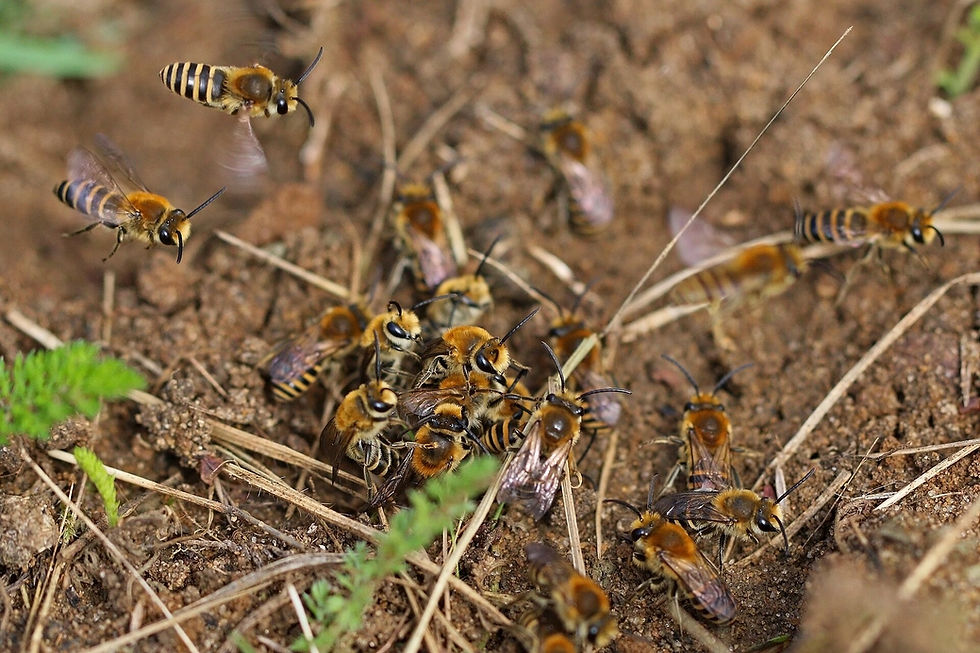
Put an ivy bee beside a honey bee and you may initially wonder what the difference is. Both can have a gingery-brown, hairy thorax and a striped abdomen, and size isn't necessarily much help either. Look more closely, however, and the ivy bee often has a noticeably darker abdomen crossed by quite distinct pale or creamy bands, giving it a cleaner, more sharply striped appearance. The thorax is typically a warm ginger or reddish brown.
From Tristan’s Notebook
One of the most useful things you can learn around bees is not when to intervene, but when not to. Sometimes the best advice I can give is: leave them alone and let them get on with being bees.
Honey bees tend to be less crisply marked, with more muted shades of brown, amber and black blending through the abdomen. There is considerable natural variation in both, however, so colour alone isn't enough for a confident identification. Where the bee is, what it's doing and the time of year can be just as revealing as its markings.
A honey-bee swarm is usually unmistakable once you know what you're looking at. We're talking about thousands of bees travelling with a queen, often settling temporarily as a dense mass on a branch, fence, wall or other structure while scout bees look for somewhere suitable for the colony to live.

A few bees on a plant, a number of bees flying low over a patch of ground, or bees repeatedly disappearing into small holes in the soil are quite different things.
Ivy bees usually nest in the ground, often favouring sunny, fairly sparsely vegetated areas. Because lots of females may choose the same good nesting site, the activity can look surprisingly intense. Add males busily searching for newly emerging females and it can all become rather frantic. Males will sometimes cluster around a female as she emerges, producing what looks, briefly, like a small writhing ball of bees.
It looks dramatic. It still isn't a honey-bee swarm.
From Tristan’s Notebook
The number of bees you can see isn’t always a good indication of what you’ve found. A few honey bees may simply be foraging, while a surprisingly busy patch of ground can be home to solitary bees. Behaviour usually tells you far more than numbers.
What should you do if you find them?
In most cases, absolutely nothing.
I realise that isn't terribly exciting advice from a beekeeper, but sometimes doing nothing is precisely the right thing to do.
Ivy bees aren't interested in attacking people. The males cannot sting at all and, although females technically can, they're extremely reluctant to do so. They don't have a communal hive full of honey, brood and a queen to defend in the way a honey-bee colony does.
If they've chosen a patch of your lawn your polytunnel or a bank in the garden, they aren't setting up permanent residence in the way people sometimes imagine. Their period of visible activity is relatively short and will disappear naturally as the season progresses. If possible, simply give the area a little space while they're active and enjoy having them there.
Please don't pour boiling water, insecticide or anything else into the holes. Apart from being cruel and unnecessary, you'd be destroying a perfectly harmless native pollinator simply for getting on with its life.
The same applies if you've spotted a small group feeding on ivy. They don't need collecting, relocating or “rescuing”. They're exactly where they're supposed to be.
What if I'm not sure?
Send me a photograph. Ideally, take one reasonably close picture so I can see the bees themselves and another from a little farther away so I can see where they are and what they're doing. Don't put yourself in the middle of a mass of insects to get the perfect photograph — nobody needs a David Attenborough moment for the sake of identification.
If it is a honey-bee swarm, I can advise you accordingly. If it's an ivy bee, another solitary bee, a bumblebee or indeed something that isn't a bee at all, I'll tell you that too.
And that's really the point of this article. Not every group of bees needs a beekeeper.
Honey bees are only one part of a much bigger and extraordinarily interesting world of pollinators. Knowing when to intervene is important, but knowing when to leave something completely alone is every bit as much a part of understanding bees.
So if you notice some unfamiliar bees this autumn, particularly around flowering ivy or a patch of sunny ground, have a proper look before deciding you've got a swarm.
You may simply have acquired some rather interesting temporary neighbours.


Comments